Miniature Sinningia Hybrids

Below are listed the hybrids involving the three miniature sinningia species:

  1. S. pusilla
  2. S. concinna
  3. S. sp. "Rio das Pedras"

This listing does not include the classical miniature sinningias, such as S. 'Cherry Chips', S. 'Super Orange', and S. 'Mercury', because I have little information on their (complex) ancestry.  Nor are the modern hybrids (such as David Harris's Ozark series) included, again because I don't know their family trees.  What I focus on in this page is hybrids that can be traced back to the species.

I am sure this list is incomplete.  I will keep updating it as I find more information.

Linda Zillich's micro-mini site offers for sale both micro sinningias and her useful booklet on growing them.

Contents

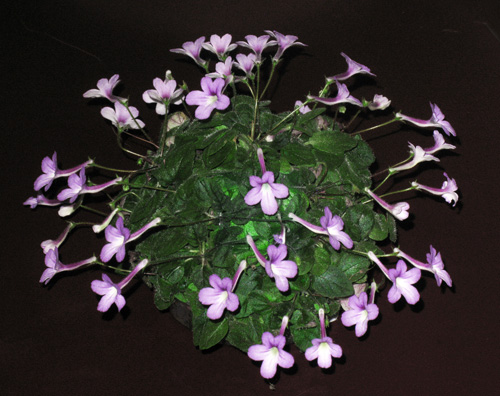
Miniature sinningia hybrids involve S. pusilla or S. concinna as ancestors (to which we must now add S. sp. "Rio das Pedras", since that species has now entered the hybridizer's arsenal).  Plants derived from crosses between S. pusilla and S. concinna are just about as small as those species, and are usually known as "micro-minis".  They include some varieties within S. pusilla, such as S. pusilla 'White Sprite' (GRW picture) and S. 'Snowflake'.

Bright Eyes

Sinningia 'Bright Eyes' (by Carl Clayberg, 1964) is S. (pusilla x concinna) x pusilla.  Because this cross was done before the official date (1966) of S. 'Wood Nymph' (which is S. pusilla x concinna),` it is likely that Clayberg independently crossed those two species to get the 'Bright Eyes' parent.

External link: GRW picture.

Cindy

Sinningia 'Cindy' (by Tom Talpey, 1965) is S. concinna x eumorpha.  Because it is a cross between two different clades, S. 'Cindy' is sterile, but S. 'Cindy-ella' is apparently a fertile tetraploid form.

Cupid's Doll

Sinningia 'Cupid's Doll' (by Ruth Katzenberger, 1966) is S. 'Ramadeva' x 'Dollbaby'.  Both the parents are probably tetraploid S. pusilla hybrids.

Deep Purple Dreaming

Sinningia 'Deep Purple Dreaming' (by Dave Zaitlin) is S. concinna x sellovii.  The flowers have roughly the size and color of S. concinna, with dramatic spotting on the corolla lobes and dotted lines on the interior, but hang vertically like those of S. sellovii.  Interestingly, the flowers are resupinate or trying to be, like the sellovii parent.  The pedicels of S. sellovii do a 180-degree rotation as they develop, to bring the "top" of the flower next to the axis (stem), and the pedicels of this hybrid do the same thing -- most of the time.

Dollbaby

Sinningia 'Dollbaby' (by Ruth Katzenberger, 1963) is S. pusilla x eumorpha.  Because it is a cross between two different clades, S. 'Dollbaby' is sterile, but there is apparently a tetraploid form which is fertile.  (That's according to the AGGS Sinningia register, but it may be that the plant distributed under the 'Dollbaby' name is the tetraploid.)

External link: GRW picture.

Freckles

Sinningia 'Freckles' (by Carl Clayberg, 1966) is S. hirsuta x concinna.  Because it is a cross between two different clades, S. 'Freckles' is sterile, but S. 'Hircon' is apparently a fertile tetraploid form.

External link: GRW picture.

Krishna

Sinningia 'Krishna' (by Frances Batcheller, registered 1973) is S. 'Ramadeva' "line bred" (according to the Gesneriad Hybrids Register).  Presumably this means that S. 'Krishna' is the result of selfing S. 'Ramadeva'.

Oengus

Sinningia 'Oengus' (by Frances Batcheller, registered 1973) is S. (concinna x schiffneri) x 'Krishna'.  Thus this hybrid has both S. concinna and S. pusilla in its background.

Pink Petite

Sinningia 'Pink Petite' is S. pusilla x leucotricha, registered by Carl Clayberg in 1965.  See also S. 'Ramadeva'.

Quasar

Sinningia 'Quasar' is S. pusilla x conspicua, registered by Al Wojcik in 1993.  I presume it does not have a supermassive black hole at its center, but I have not seen it, so I cannot be sure.

Ramadeva

Sinningia 'Ramadeva' (by Frances Batcheller, registered 1973) is S. pusilla x leucotricha.  See also S. 'Pink Petite'.

Because this cross spans two different clades, the outcome should be sterile.  However, the Gesneriad register shows several crosses with S. 'Ramadeva' as parent, so it is likely that this one is a fertile tetraploid form.

For instance, S. 'Benten' was registered by Frances Batcheller in 1973, as S. 'Ramadeva' x barbata, and S. 'Kore' as S. 'Ramadeva' x richii.  I have to say, hybridizers were tougher in those days.  You get a fertile tetraploid hybrid of S. leucotricha and S. pusilla, and right away you cross it with S. richii and S. barbata?  No wimpy S. eumorpha or S. cardinalis crosses for Mrs. Batcheller, no sir.

Razzmatazz

This plant looks a lot like S. concinna.  The GRW has a picture.  According to Carolyn Ripps, S. 'Razzmatazz' is "a hybrid made by the late Kiku Shimomura of the Greater NY chapter.  It has been around for more than 20 years" [written in 2009].

S. sp. "Rio das Pedras" x pusilla 'Snowflake'

Peter Shalit did this cross.  He reported that he grew out about 30 F1 seedlings, all of which appeared to be sterile except for one.  The seedlings from that plant were very uniform and similar to the F1 but larger, which led him to believe they are fertile tetraploids.  These plants are similar to the "Rio das Pedras" parent, which makes him reluctant to release them even though they reproduce readily from seed.  Dale Martens has grown some progeny seedlings and got no white-flowered plants (one would expect some white-flowered plants if the plants were not tetraploid).

Tinkerbells

Sinningia 'Tinkerbells' (by Elena Jordan, registered 1971) is S. concinna x aggregata.  According to the legend recounted by Carolyn Ripps, there was one seed from the cross, and this was the result.  In hybridizing: do not throw away anything.

Toad Hall

Sinningia 'Toad Hall' (by Jim Steuerlein) is S. sp. "Rio das Pedras" x conspicua.  It is more conspicua-size than rio-size, but it does have some of the conspicua fragrance.

See the page for this hybrid.

Wood Nymph

Sinningia 'Wood Nymph' (by Lyndon Lyon, 1966) is S. pusilla x concinna.  Because it is a cross between two species in the same clade, S. 'Wood Nymph' is fertile.  (Or rather, not quite sterile, according to Peter Shalit.)  S. 'Ruffled Wood Nymph' is S. 'Wood Nymph' back-crossed to S. concinna.

External links: GRW pictures of S. 'Wood Nymph' and S. 'Ruffled Wood Nymph'.

Yma: flower

Yma

Sinningia 'Yma' (by Jim Steuerlein) is S. sp. "Rio das Pedras" x sp. "Florianopolis".  It does have some of the bullate leaf texture from the "Florianopolis" parent, but none of the wool on the stems and under the leaves.

Like the "Florianopolis" parent, my plant of this hybrid tends to sprawl.