| Species list |
Hybrids list |
Tubers list |
Topics list |
Site index |
What's new |
Home page |
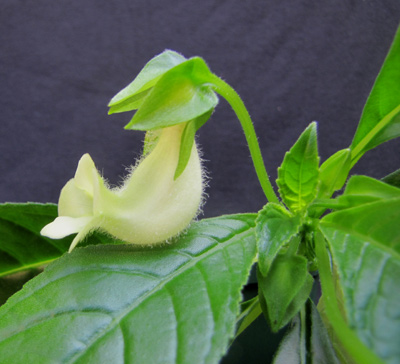
Sinningia barbata has greenish-white flowers with a 90-degree bend in the middle.
|
The 2007 Gesneriad Society convention in Miami had a really great sale as far as sinningias were concerned. One of the prizes I brought home was a plant of Sinningia barbata, which I could not recall ever having seen before, much less owned. |
S. barbata is not well known, but whatever renown it does possess rests on three unusual characteristics.
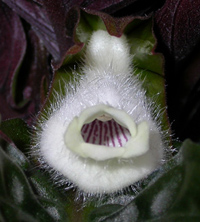
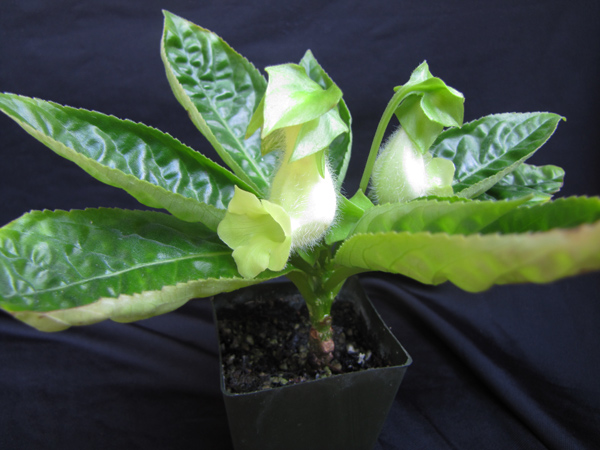
FlowersThe species name barbata means "bearded", presumably a reference to the hairy flowers. Hairy they definitely are. Flowerbuds became visible at the beginning of November 2007 (see below), and opened at the end of the month. The flowers have a greenish tinge, which is unusual. Also unusual is the almost 90-degree bend in the corolla. Starting at the base, the corolla inflates into a kind of pouch, then turns at almost a right angle, constricts to a small tube, and then flares into the usual five-lobed entrance. At this point in the development of the flowers, the reproductive parts (stamens and stigma) are still far back in the pouch, well away from the entrance to the corolla tube. The greenish color, the unusual geometry, and the well-hidden reproductive apparatus make one wonder about what sort of pollinator these flowers are designed to attract. |
|
|
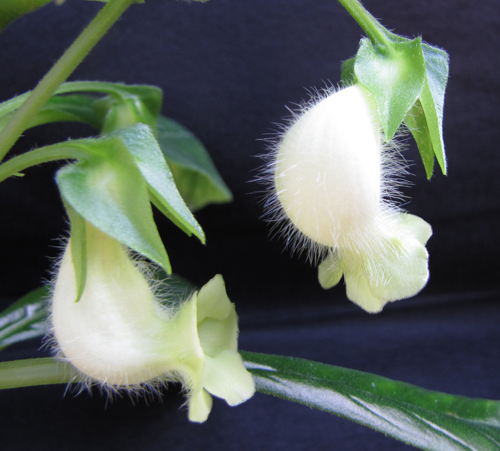
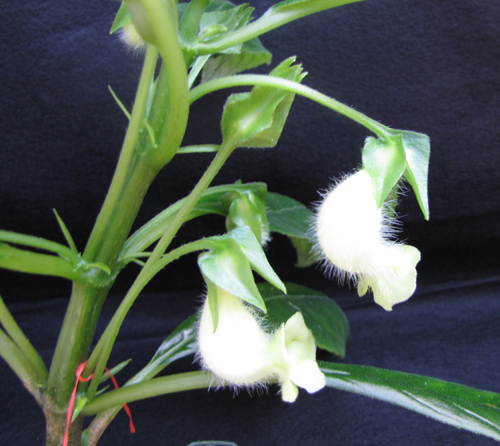
This picture shows a closeup of two flowers, taken in October 2012. The hairiness of the flowers is clearly visible, as are the 90-degree bend in the corolla tube and the 90-degree angle that the base of the tube makes with the pedicel. |
|
|
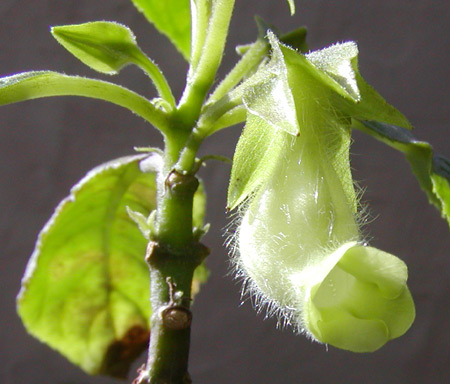
FlowerbudsIn November 2007, the plant developed two flowerbuds. Although S. barbata is not closely related to Paliavana tenuiflora, its flowerbuds bear a distinct resemblance to those of the paliavana species. Comparison of this picture with that of P. tenuiflora shows that both have calyxes that completely enclose the developing flowerbud and in both the junction where the calyx lobes meet is raised into a ridge or keel. In most species of Sinningia, the calyx is relatively small, and the corolla protrudes well beyond the calyx early in its development. Presumably, S. barbata has independently hit upon the same strategem as P. tenuiflora (and Vanhouttea lanata and V. brueggeri) to protect the corolla and internal flowerparts during the early stages of its growth. |
|
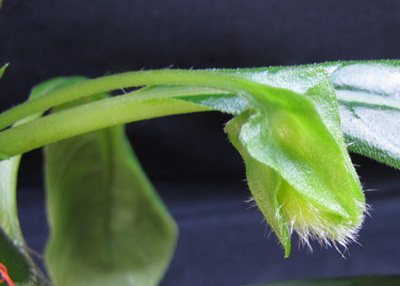
This picture shows a developing flowerbud of Sinningia barbata at a stage later than the above picture. The corolla bud is just emerging from the calyx lobes. Even without seeing the corolla bud, one can tell this is a developing flower and not a developing fruit, as will become obvious from the next picture. The key is the angle of the pedicel. |
PedicelsThis picture shows the two flowers in an earlier picture on this page, but in a larger view, in order to show the difference between the pedicel of a flower and that of a fruit. The two flowers have arching pedicels. By contrast, the developing fruit has a straight, almost vertical pedicel, in this case with a piece of red dental floss tied around its base (no, the plant doesn't make dental floss on its own, I use floss to mark pollinated fruits and every so often to get stuff out from between my teeth). Also visible in the picture are the characteristic very narrow paired leaves at the base of every pedicel. The vertical pedicel of the fruit appears to be a preparation for the seed dispersal mechanism known as the splash cup. |
|
In their paper on the geographical distribution pattern of sinningias, Perret et al. provided a table showing the blooming season of most sinningia species, based on whether herbarium specimens obtained during a given month had flowers. By that standard, Sinningia barbata was remarkable for having blooms during eleven of the twelve months!
This strongly suggests that S. barbata is close to everblooming in its native habitat -- and that it does not go dormant. Under my conditions, however, it most definitely did go dormant, so thoroughly that I almost gave up on its waking up. After the picture of the tuber taken in January 2009, the plant slept until July 2009. Fortunately, a cutting I had taken did not go dormant, even though it remained small, so I had a little insurance. As of late July 2009: both pieces doing well, but neither blooming.
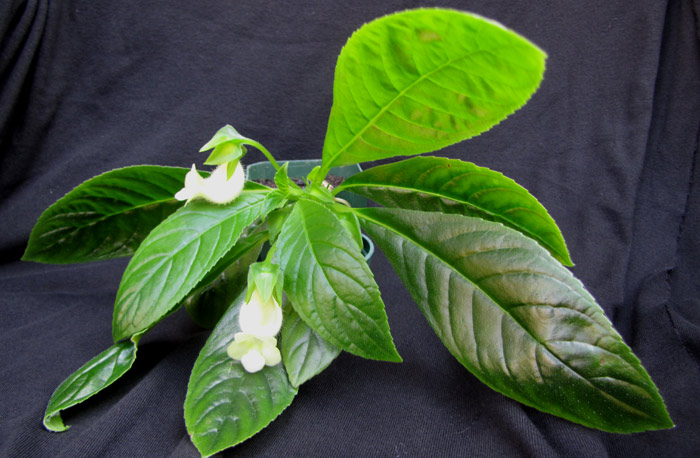
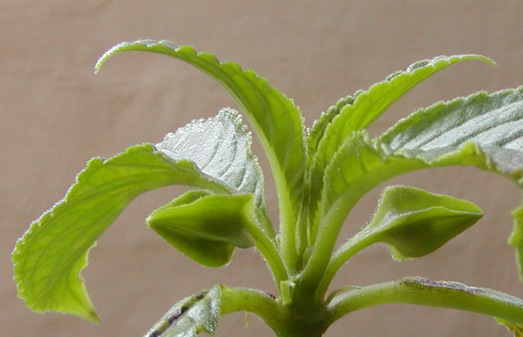
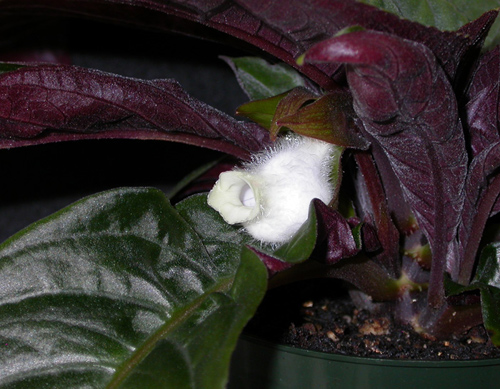
Dark-leaved formThe above pictures show the standard form of S. barbata. It has ordinary herbaceous leaves, plain green above and below. Once established, it is fairly easy to grow, although a shy bloomer. Another form, represented by the cultivar "Tancredo Neves", as distributed by Mauro Peixoto's Brazil Plants operation, has dark shiny leaves. As can be seen in the lower picture on the right, the leaves are are maroon underneath. The upper picture on the right shows another feature of the "Tancredo Neves" form: the dark red petioles. |
|
|
One would not take them for the same species, were it not for the similarity in flowers. This form also has the four-angled stems of the plain form. Unfortunately, the "Tancredo Neves" form is not nearly as trouble-free as the plain-green-leaved form. It is highly susceptible to powdery mildew. Mike Kartuz has reported the same experience in growing the two forms of S. barbata. It has been a struggle for me to keep my few small plants alive. As of this writing [July 2011], none of the plants has bloomed. |
|
|
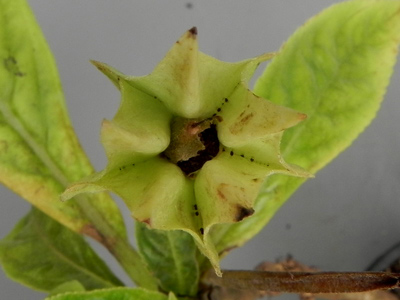
This picture, by Mauro Peixoto (www.brazilplants.com) of his own plant, shows the fruit of Sinningia barbata. It appears to be the fruit type called a "splash cup". Instead of splitting open along the side, like most sinningia fruits, this one opens by peeling back a lid. The fruit is held more or less horizontally, facing up. Then a drop of rain landing on the fruit will knock the seeds out of the fruit and at least a little distance from the original plant. This can be a more effective method of dispersal than the normal capsule when rain is more abundant than wind. In preparation for his thesis, John Boggan grew many sinningia species, including this one. He pollinated a flower and noted that the "calyx/ovary become erect after pollination, pedicel elongates." Also: "No dehiscence; superior portion shrinks/disintegrates... no obvious method of dispersal. Splash cup?" |
| Plant Description |
|
| Growth | Indeterminate |
| Habit | Stem upright, square |
| Leaves | Shiny dark green, reverse maroon (in theory, but not on my plant) |
| Dormancy | Small tuber, or none (see the picture) |
Flowering |
|
| Inflorescence | Axillary cyme, usually with 1-2 flowers |
| Season | Mine bloomed for the first time in late November [2007], but that may be because it is a small and mistreated plant. In 2008, it bloomed in July-August. See the discussion above. |
| Flower | White/green (see above) |
Horticultural aspects |
|
| Hardiness | S. barbata comes from the part of Brazil not far south of the equator (mainly Bahia state), so it is unlikely to be very cold-tolerant. A rooted cutting of the 'Tancredo Neves' variety has survived 40 F [< 4 C] nights outdoors, although I do not expect it to endure near-freezing temperatures. |
| Propagation | From stem cuttings. Leaf cuttings have rotted rather than rooting, and I have not been able to set seed on my plant yet. |
Botany |
|
| Nectaries | Two, white, elongated (see picture below) |
| Taxonomic group | By itself in the Corytholoma clade. |
|
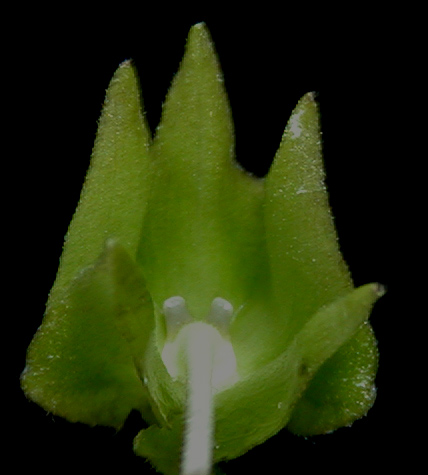
NectariesSinningia barbata has two prominent dorsal nectaries, as shown in the enlargement at the right. The picture shows the calyx with the nectaries just above the base of the style. External LinkSee a picture on Ron Myhr's Gesneriad Reference Web. PublicationSinningia barbata was first published (as Gesneria barbata) in 1823 by Christian Nees von Esenbeck (1776-1858) and Carl Friedrich Phillip von Martius (1794-1868). It was transferred to Sinningia in 1887 by Nichols. Etymology: Latin barbata ("bearded"), from barba ("beard"). And what do you suppose was one of the main responsibilities of a barber? |