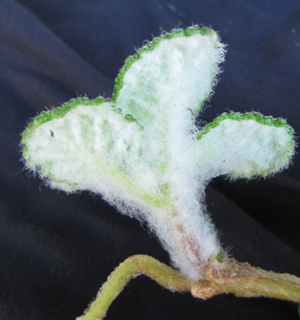
Sinningia sp. "Florianopolis"

Florianopolis

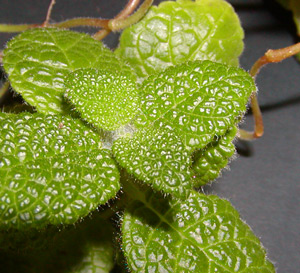
    This species is remarkable for the thick white wool on the back of new leaves and on the tips of new shoots.

  1. In the Wild
  2. Propagation
  3. Hybridization
  4. Feature table
  5. External link
  6. Publication and etymology


Mauro Peixoto described finding this plant on Gesneriphiles:

Dr Alain Chautems is preparing the Gesneriaceae family of the "Illustrated Flora of Santa Catarina State" and had some doubts about a few [specimens of] dried material that he was analyzing... One of the doubts was a Sinningia that looked like a small leaved S. lineata that someone had collected years ago at a place called "Testa do Macaco" (Monkey's Forehead). So we went to Florianopolis, Santa Catarina. Dr. Ademir Reis from the UFSC (Federal University of Santa Catarina) hired a local guide to take us there. After half hiking and half climbing up a mountain for 2 hours we finally reached the plant!

Florianopolis is an island off the coast of Santa Catarina state, in southern Brazil. The plant was growing on vertical hillsides (one of the favorite sinningia growing places, it seems, since S. nivalis, S. hatschbachii, and S. calcaria grow in similar situations).
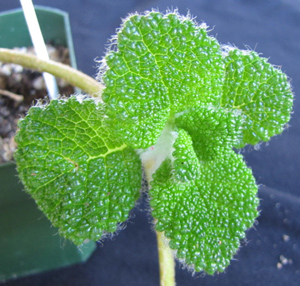
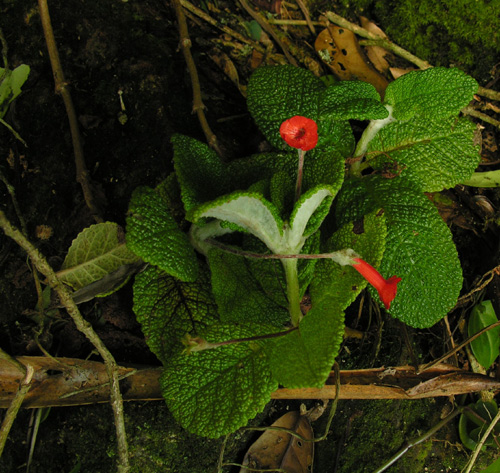
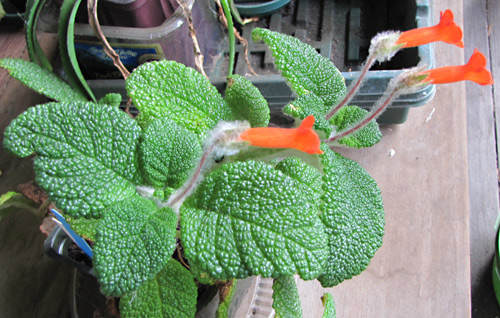
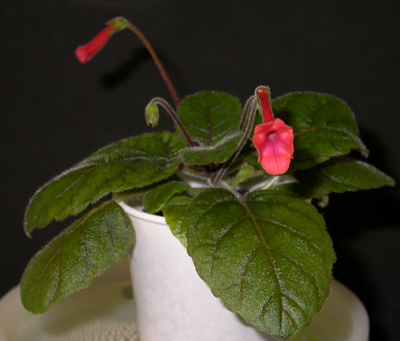
This plant is notable for its hairy leaf undersides. Mauro said the plants he found did not have sticky leaves, but the plant I have does (but not all of the time).  Another remarkable feature is the quilted leaves, more like an episcia than a sinningia.

The hairiness on my plants is on the stem of the top two internodes and the reverse of the top two pairs of leaves.  It's not easy to tell whether the hairs on the stems and leaves lower down just drop off or somehow mat against the plant surface.  I don't see any signs of fallen hairs, but neither do the lower stems have matted hairs.  In S. leucotricha, the hairiness of leaves and stems is diluted by the expansion of the leaves and stems themselves.  This does not appear to be the case here, since the upper internodes and leaves have a very hairy appearance even when they have reached full size.

Florianopolis
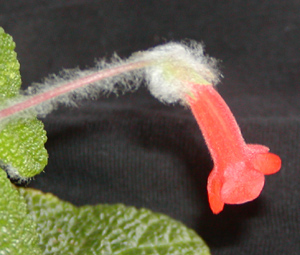
bullata: flower

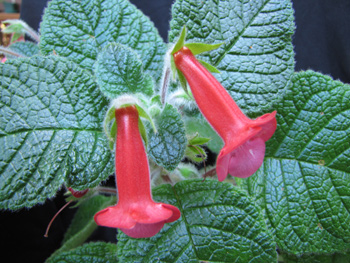
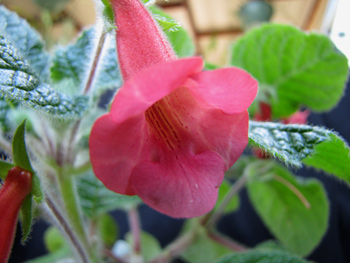
Mauro's pictures show flowers much like those of S. lineata: orange-red tubes, flaring lobes, and some darker red markings in the throat.  According to Mauro, the plant blooms year-round in his conditions, in stark contrast to my plant, which has only bloomed once, for a couple of weeks.

In the Wild

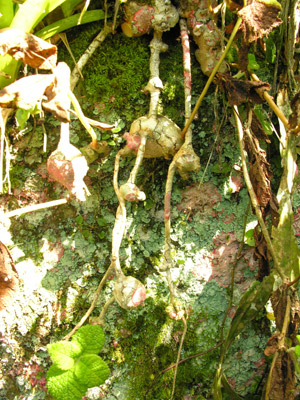
The next two pictures are courtesy of Alain Chautems.  The picture below shows this species growing on an almost vertical slope.

Florianopolis

Other specimens were found near bromeliads. Some appear to have a chain of tubers connected by ropy stems.

Florianopolis

Propagation

bullata: fruit

Some other people have written that they have not been able to propagate this species from cuttings, but that it blooms almost constantly.  On the other hand, I have had no difficulty rooting cuttings of this plant, but mine almost never blooms.  One more example of the importance of distrusting horticultural advice, even my own: different environments give different results, and the grower may not be aware of the crucial factor.

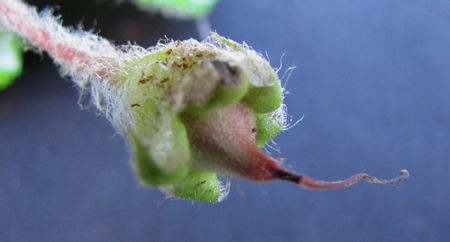
This picture shows the interesting fruit of this species.  The calyx lobes are curled back from the pudgy reddish capsule.  What look like seeds from an older fruit are caught in the white wool on the backs of the calyx lobes.

At any rate, I don't do anything special for cuttings of this species: just pop them in a covered propagation box, in my regular growing mix.  Wait a few months.  Remove when golden brown on the... ooops, sorry, wrong recipe.

Hybridization

Jim Steuerlein of Florida has done a number of crosses with this species.  He has crossed it with Sinningia macrostachya, S. eumorpha x piresiana, and S. sp. "Rio das Pedras".

Wallace Wells has crossed this species with S. insularis.  As of February 2010, it had not yet bloomed.

Mauro Peixoto found a plant he believes to be a natural hybrid between this species and S. leopoldii.  It has the quilted foliage of the "Florianopolis" parent, but not the hairiness on the leaf reverse and on the stem.

According the Mauro, the F1 hybrid has not been distributed, so plants found in the United States under the name Sinningia sp. "Florianopolis" x leopoldii were actually propagated from seed from that hybrid, and are therefore F2 plants, which will not be identical with the F1 parent.  Thus the proper designation is

    Sinningia (sp. "Florianopolis" x leopoldii) x self
       or
    Sinningia (sp. "Florianopolis" x leopoldii) F2

Feature table for Sinningia sp. "Florianopolis"

Plant Description

Growth Indeterminate
Habit Sprawling stem(s)
Leaves Pebbled or quilted surface, hairy reverse (stems hairy too). The leaves are occasionally slightly sticky, but not nearly as sticky as those of Sinningia amambayensis
Dormancy No dormancy observed on young plant indoors.  The plant does have a tuber, and cuttings form a new tuber after just 3-4 months.

Flowering

Inflorescence terminal cluster
Season  
Flower Orange-red, tubular

Horticultural Aspects

From seed No data yet.
Hardiness Has (apparently) survived 30 F (-1 C) without damage (January 2009).
Propagation From stem cuttings, which root easily for me.  I have not tried leaf cuttings, and have had no flowers, thus no seed.
Recommended? Yes, just the woolly stems are reward enough.

Botany

Taxonomic group Given that it forms a fertile hybrid with S. leopoldii, it must be in the Dircaea clade.  If I had to guess, I would place it close to S. macropoda.


Florianopolis

External Link

Mauro Peixoto's Brazilian Plants site has a page about S. "Florianopolis", with a picture showing the striking flowers.

Publication

None yet.