- Origin
- Specimens
- Closeups
- Innards
- Underside of plant
- Hybridization
- Feature table
- External links
- Publication and etymology
A comparison table relates S. concinna to the other miniature species.
| Species list |
Hybrids list |
Tubers list |
Topics list |
Site index |
What's new |
Home page |
A finicky micro species, requiring at least 50% humidity, but well worth the effort for those who can manage it. The flowers are very elegant.
|
|
A comparison table relates S. concinna to the other miniature species. |
|
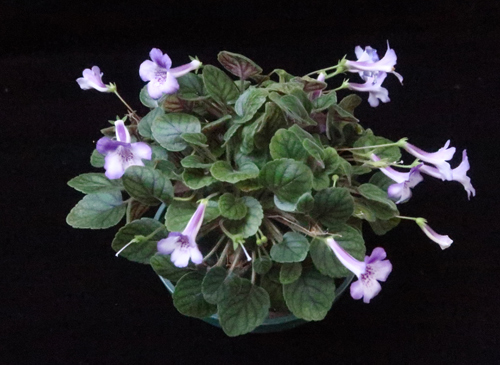
Sinningia concinna has a reputation for being demanding and difficult, requiring high humidity, usually involving terrarium conditions. This may not always be the case. Here we see a plant grown in the open, unenclosed, in a kitchen window for several years. The humidity is generally around 50%. The plant blooms best in the winter months. |
|
OriginAlain Chautems provided this information on the origin of Sinningia concinna: The first decription of the species as Stenogaster concinna by J. D. Hooker in 1861 (Botanical Magazine, Tab. 5253) only mentions that the plant was observed in "Messrs. Veicht and Son's Nursery at Chelsea in the month of April last, but it is not known from what country it came, nor by whom it was imported....". Soon after that, it appeared in other Horticulture journals, like Flore des Serres by Van Houtte and Illustration Horticole by Lemaire and it was supposed that based on its morphological affinity with Sinningia hirsuta, its origin should be in Brazil. Hanstein in Flora Brasiliensis (1864) maintained this opinion. I have never found any material there and no local herbarium has anything like it in their collection, but who knows, such a tiny plant may have survived in some remote and hidden rocky outcrop in the mountains of Rio de Janeiro.... Thus, as far as we know, Sinningia concinna is extinct in the wild and exists only in cultivation. One therefore wonders how many clones of this species there are -- perhaps not very many. |
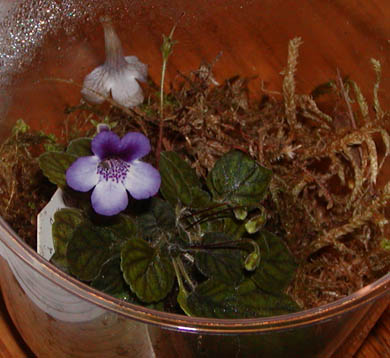
Jeanne Sorci's plantThis plant was grown by Jeanne Sorci, a former member of the Peninsula Gesneriad Society. She grows it in an enclosed bubble (the top was removed for the photo). The flower is small but striking. As can be seen, Jeanne grows it in moss. |
|
|
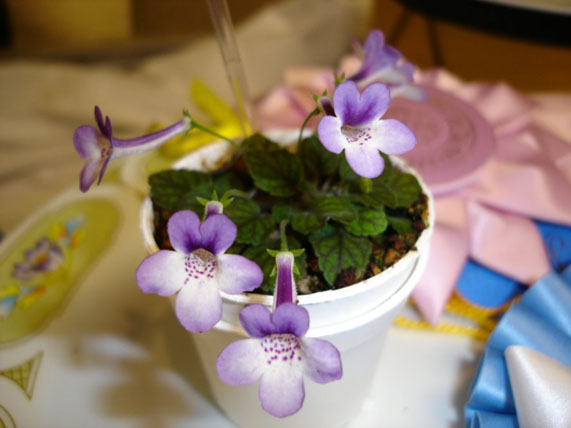
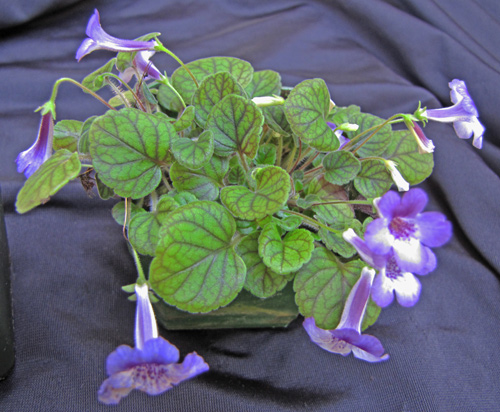
David Harris's plantThis is the prize-winning plant grown by the renowned small-sinningia hybridizer David Harris (of "Misery"). It is a tribute to his accomplishment that everybody was so impressed that he had a plant with six open flowers (there are two in back of the one on the right). This species is not for the faint of heart or the easily discouraged! This is David's picture of his own plant. |
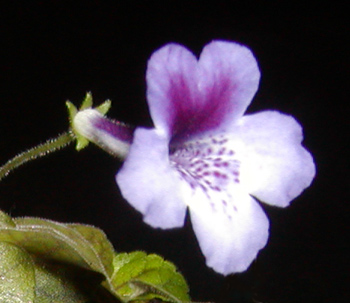
Fred Stryker's plantFred Stryker was a long-time member of the Peninsula Gesneriad Society who worked for many years as a chemist for IBM in San Jose (California) and before that served in the South Pacific during World War II. He was particularly skilled in growing the micro sinningias. When he died in February 2009, I inherited his micro collection. This picture, taken on 6 April 2011, shows the Sinningia concinna from his collection. According to his label, it was planted in "Supersoil", the same straight-from-the-bag mix that I use for all my sinningias, so perhaps the plant is not as fussy about potting medium as its reputation would indicate. The picture at the top of the page shows a flower from this plant. Fred was the source of Jeanne Sorci's plant as well. |
|
|
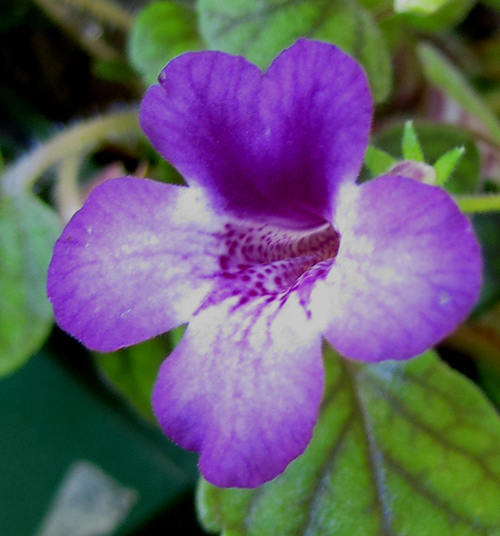
The interior of the corolla tube of Sinningia concinna is densely spotted, which makes its flower the most dramatic of the three micro species. On each side of the floor of the tube is a ridge, which creates a groove between them. The two ridges and the groove can be seen on the underside of the exterior of the corolla as well. The trumpet-shaped corolla tube suggests that this flower is pollinated by butterflies, moths, or hummingbirds, but the color makes hummingbird pollination unlikely. If this species is indeed pollinated by butterflies, perhaps the purpose of the groove is to guide the insect's proboscis into the flower in the right position to pick up or deposit pollen. |
|
|
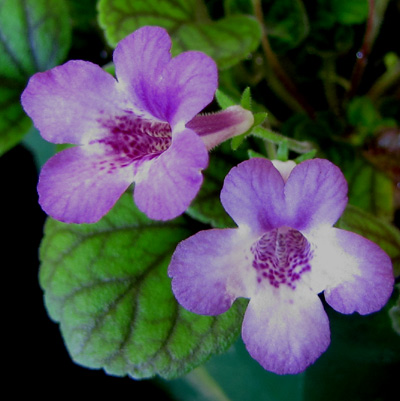
Even on the same plant, Sinningia concinna flowers can have different coloration. The flower on the left has saturated purple on all five lobes, while the one on the right has a normal amount of white on the lobes. Note that the pictures on this page were taken by different people at different times with different cameras. Capturing purples with photography is difficult, which accounts for the the varying shades of purple in the pictures. I get the closest match to the original color by photographing indoors in natural light with no flash. The resulting long exposure time (about a second) demands a tripod. Even then I have to photoshop the picture, lowering the brightness, to increase the accuracy of the color. |
|
|
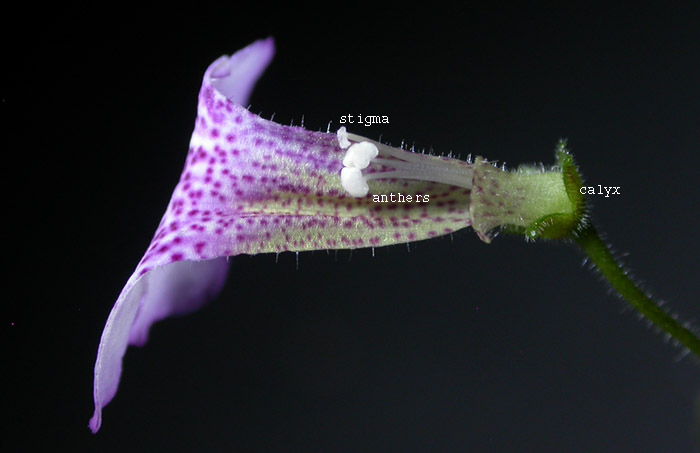
This photo, courtesy of Dale Martens, shows the reproductive parts of the Sinningia concinna flower. I have marked the stigma (pollen-receiving part) and anthers (pollen-dispensing part), as well as the calyx, which encloses the ovary. When a pollen grain is deposited on the stigma, it germinates, grows a tube down the style that leads to the ovary, where it fertilizes an ovule, which turns into a seed. That's the theory, anyway. I have never managed to get seed from Sinningia concinna. |
|
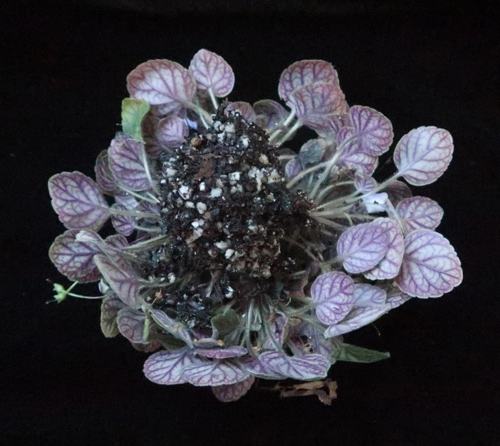
UndersideThis photo shows the underside of the plant. Features to notice are
The potting mix is just my standard straight-out-of-the-bag commercial soil ("Supersoil") to which I added some perlite. |
HybridizationSeveral hybrids have been made using S. concinna to get miniatures. It was crossed with S. pusilla and S. hirsuta quite early, and with S. sellovii and S. muscicola ("Rio das Pedras") more recently. See the micro page for details. |
| Plant Description |
|
| Growth | Indeterminate |
| Habit | Small rosette. Eventually clustering. |
| Leaves | Dark green, with red backs |
| Dormancy | Usually not dormant. |
Flowering |
|
| Season | Intermittent bloomer. Main blooming season = winter? |
| Flower | Corolla trumpet-shaped. Two corolla lobes purple, three white. Tube interior white densely spotted with purple. Floor of tube has longitudinal groove. |
Horticultural aspects |
|
| Growing conditions | I grow mine unenclosed in natural light (a window) where the humidity is always 50% or greater. |
| Propagation | Setting seed is not easy. The simplest propagation method is division of a plant with multiple crowns. |
| Hardiness | Probably intolerant of freezing temperatures, but no data yet. |
Hybridization |
|
| Hybrids with this species | See listing. |
Botany |
|
| Taxonomic group | In a group with S. pusilla and S. aghensis within the Corytholoma clade. |
Mauro Peixoto's web site has a page on S. concinna.
Sinningia concinna was first published (as a Stenogastra) in 1861 by Hooker. Nichols transferred it to Sinningia in 1887.
Etymology: Latin concinna ("symmetrical, elegant").