Sinningia 'Serenade'
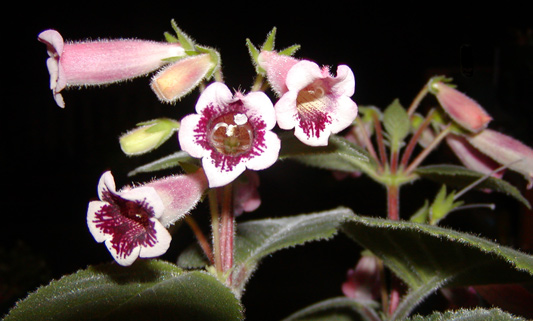
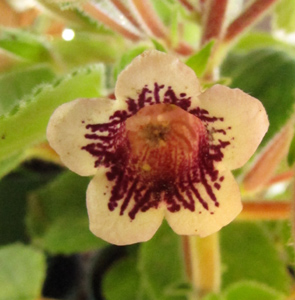
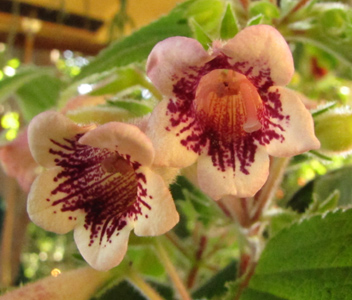
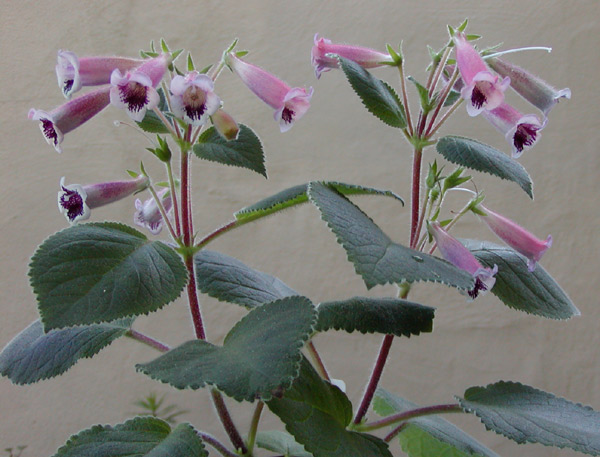
Sinningia 'Serenade' was hybridized by Ruth Coulson of Balcolyn, Australia (north of Sydney). Although she says she is unsatisfied with it, I think the floral color is very attractive. Also striking is the variability: some flowers (such as two in the picture) are almost peloric, with the purple spread over all five lobes, while other flowers are more conventional (like the rightmost open flower) with the purple on only a single lobe. Another, not shown in the picture, has purple on three lobes. An unpredictable serenade!
After my indoor plant bloomed under lights in early spring 2008, I cut it back. It began a second cycle of bloom in late June 2008, at a time when my outdoor plant was just showing flowerbuds.
Ruth says that this hybrid was the result of crossing Sinningia conspicua with a hybrid which included Sinningia cardinalis 'Skydiver' and Sinningia bulbosa.
I crossed this plant with a couple of my own hybrids, both S. 'Texas Zebra' x 'Peninsula Belle'. One of the resulting plants has peloric flowers, and I named it 'Coven'.
One point of interest in Sinningia 'Coven' and its siblings is that they contain (at least) the following seven species in their ancestry: