Sinningia sp. "Santa Teresa"

  1. My Plant
  2. Getting this species to bloom
  3. Upon receiving a lemon...
  4. Hybridization
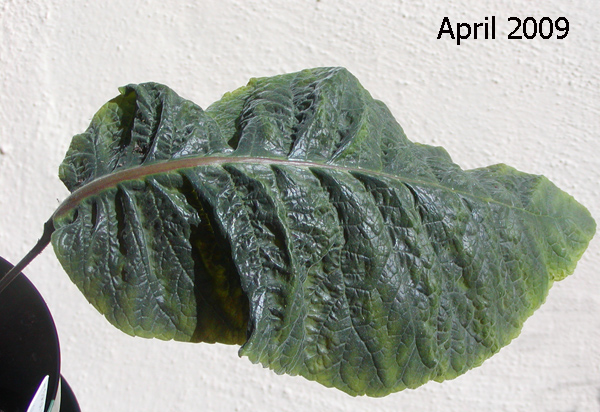
  5. The nature of its leaves
  6. Comparison to S. defoliata (and S. calcaria)
  7. Feature table

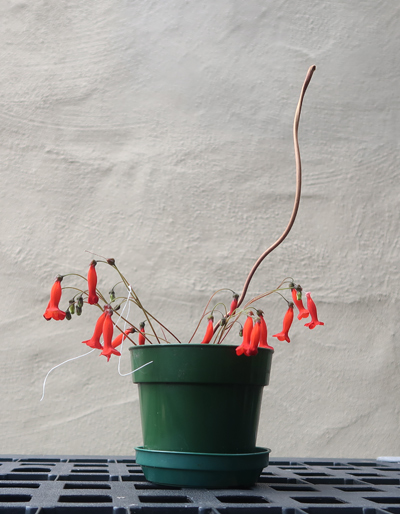
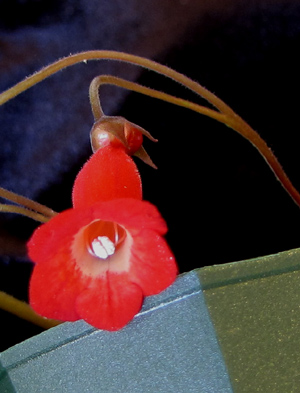
The unpublished species Sinningia sp. "Santa Teresa" is unusual in a couple of respects.  The flowers are borne in striking fashion, on stalks which emerge directly from the tuber.  In this regard, it resembles Sinningia defoliata, even though the two species are not closely related.

Normally, the plant flowers after the leaves have dropped, although not always (see below).

Sinningia santa teresa

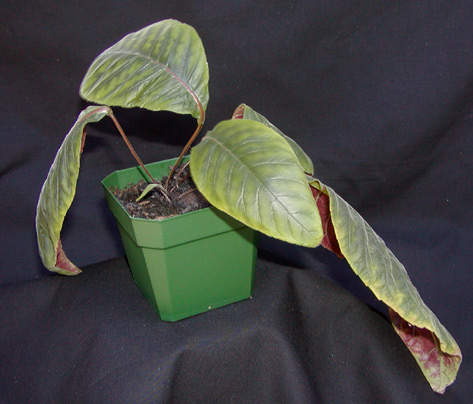
The plant habit is unusual as well.  At the 2009 Gesneriad Society convention, Mauro Peixoto showed an interesting photograph of this species in habitat, showing the leaves hanging vertically down a slope.  At first glance, the plants could have been unifoliate streptocarpus plants (such as Streptocarpus haygarthii) that have a similar habit.

My Plant

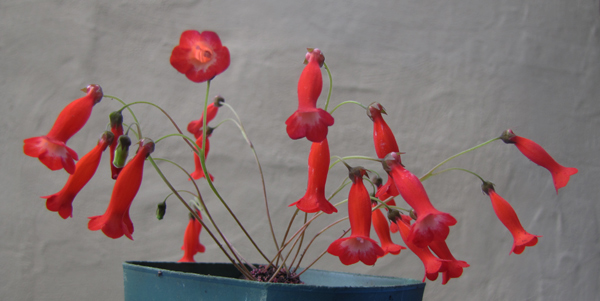
This rather out-of-focus picture looks pathetic compared to the results that Karyn Cichocki of New Jersey achieves with this species.  However, she gets flowers every year, while these were the only flowers I had ever had on this species until 2008.

I had numerous tubers of this species, started from the seed provided by Mauro Peixoto at the 2002 AGGS convention in New Jersey.  Every year I hoped for flowers; every year, except that once, I was disappointed.  Gradually the number of tubers dwindled, as each year one or two didn't come out of dormancy.

Then I retired.


Sinningia santa teresa

Getting Sinningia sp. "Santa Teresa" to bloom

My retirement had a noticeable effect on my plants.  Although they tolerated the weekly droughts that my employment caused, they were not always pleased.  Some of them let me know that by flourishing once regular watering commenced after my retirement.

One of these plants was Sinningia sp. "Santa Teresa".  Instead of two scrawny leaves, it put out six more-or-less healthy ones.  And in November it began making flowerbuds.

What conclusion do I draw?  This species does not like the watering regime it experienced during the years of my servitude.  Evenly moist is more like it.  Those of you who wick your gesneriads should have better luck.

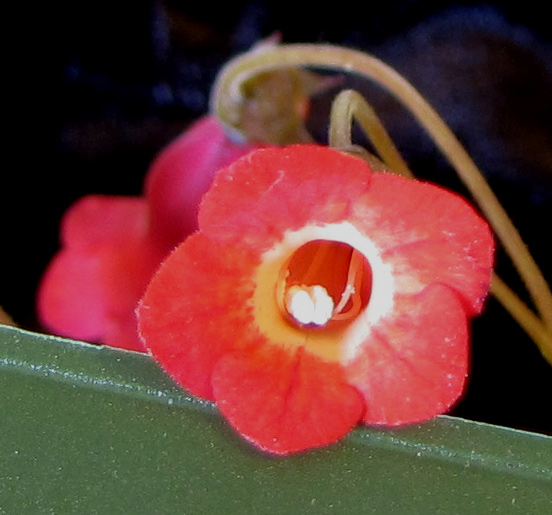
The picture to the right is unusual in a couple of respects.

First, the plant is blooming before dropping all its leaves.  Karyn's pictures and the one at the top of this page show the normal situation: the plant flowers after dropping all its leaves.  This plant, however (not the same one as pictured at the top of the page -- that one is long dead), not only sent up flowerstalks before dropping its leaves, it has also sent up a new leaf before all the flowers have opened.

Second, the flower is peloric.  This is convenient for photography, because the flower doesn't hang vertically, the way most flowers on this species do.  Also, it clearly shows the white in the throat of this plant's flowers.


Santa Teresa plant

Not Unifoliate

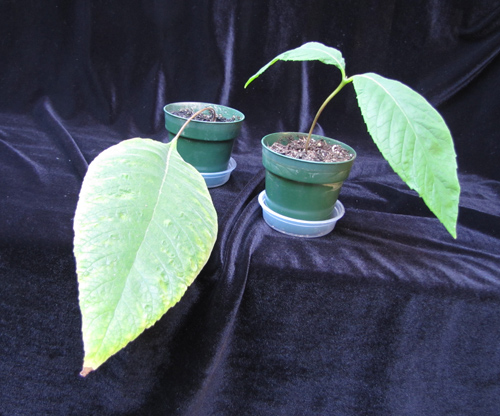
This picture was taken August 2008.  Five leaves and a sixth on the way.  I used to call this plant "unifoliate", but obviously that's not accurate.  The older the tuber, the more leaves the plant has.

This plant is in a 3.5-inch [9 cm] pot.

Making lemonade

When I was knocking one of my smaller plants out of its pot to transplant it, the one leaf broke off at the base of the stem.  At first I thought, "What a shame", and expressed that sentiment aloud, although not quite in those words.  But then I realized that here was another opportunity to gather information for Sinningia & Friends.

I put the pot with the now bare tuber aside, and put the severed stem and leaf in soil, then enclosed them in a plastic bag.  That was on 4 May 2009.  On 28 July 2009, almost three months later, I carefully dug up the cutting to see what was happening.  There was a small tuber (about 5 mm in diameter) at the cut end of the stem.  Several roots (up to 1 cm long) were emerging from the same region.

In the meantime, the original tuber is just sitting there.

It will remain to be seen whether the tuber puts up new stems -- and if so, when.  In any event, we will learn something.  Obviously, there are lots of variables here we aren't controlling, and we're only running a single test, but one test is waaay better than none.  Stay tuned.

[See here for an update as of July 2010.]

The Nature of its Leaves

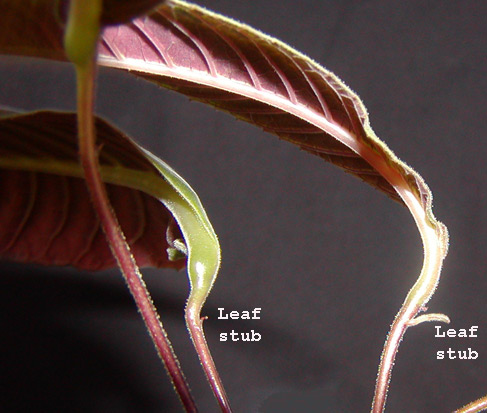
Sinningia sp. "Santa Teresa" usually has one or more leaves, each borne on what looks like a wiry petiole 1-3 inches [2-7 cm] long growing directly from the tuber.  However, observation of a second rudimentary leaf at the base of the blade convinced me that the apparent petiole was actually a stem, and this was confirmed by Alain Chautems.

The picture below shows a "leaf stub" on two stalks which would otherwise appear to be petioles.  As the primary leaf matures, the leaf stub usually dries up and falls off, much like the smaller of the two cotyledons on a streptocarpus seedling.


Santa Teresa leaf stubs

Hybridization

To the best of my knowledge, only one hybrid has been created with this species.  Using pollen supplied by Karyn Cichocki, Dale Martens crossed it with S. pusilla, to create the plant she named S. 'Heartland's Flashlight'.  I expect that more crosses will be made as people learn how to get this species to bloom.


Comparison to other species

Neither Sinningia sp. "Santa Teresa" and Sinningia defoliata appear to have stems, although that appearance is misleading.  They cannot be mistaken for one another, however, since they are quite different in appearance.  Actually, S. sp. "Santa Teresa" bears a superficial similarity to S. calcaria, to which it is not closely related at all.  A nonblooming S. calcaria with just one leaf may strongly resemble S. sp. "Santa Teresa", and it may be necessary to examine the tuber or the leaf margins to distinguish the two.

Here is a comparison between the three species.

  S. sp. "Santa Teresa" S. defoliata S. calcaria
Growth habit One or more (usually) single-leaved wiry stems (4-10 cm long), giving the appearance of petioles growing directly from tuber One or more short (less than 2 cm) single-leaved stems, giving the appearance of leaves growing directly from tuber Short wiry stem with 1-4 leaves at terminal point
Leaf shape 1-6 inches long, length-to-width is about 3:1 Elliptical, up to 12 inches long, length-to-width usually less than 2:1 2-8 inches long, length-to-width is about 1.5
Leaf margin Almost smooth, very slight indentations Smooth Indented, especially toward the tip
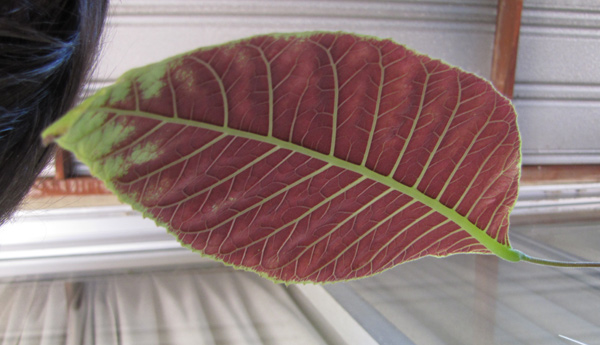
Leaf back Reddish, secondary veins in low relief Green (no trace of red) Reddish, secondary veins in high relief
Tuber Spherical Spherical, sometimes with offsets Normal, with depressed center ("bagel tuber")
Inflorescence Cyme with peduncle, emerging directly from tuber, flowers pendant Pedunculate, emerging directly from tuber Terminal cyme, very short peduncle (ca. 1 cm long), flowers almost horizontal
Flower shape and color Tubular, red with white throat Tubular, red Tubular, orange or orange-red


Feature table for Sinningia sp. "Santa Teresa"

Plant Description

Growth Determinate
Habit One or more short stems, usually dark red, each with one leaf.  Sometimes a stem has a second leaf (usually small and deciduous but rarely larger and persistent).
Leaves One to several, normally one to a stem. Top dark green, reverse red.
Dormancy Full dormancy; stems deciduous

Flowering

Inflorescence Cyme with peduncle, emerging directly from tuber
Season Blooms in autumn
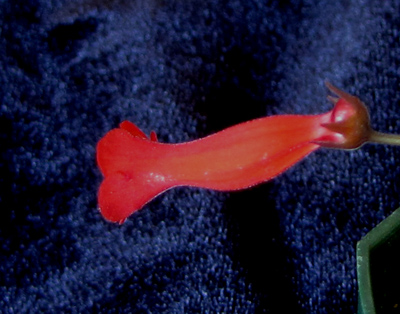
Flower Tubular, red with white throat

Horticultural Aspects

From seed 26 months to bloom, under my conditions, which were not optimal
Hardiness Has survived 32F (0C) in my back yard
Recommended? Yes and no.  S. defoliata is at least as interesting and easier to bloom.  However, S. sp. "Santa Teresa" is more compact.  If you grow it, be sure to give it plenty of water.

Botany

Taxonomic group The aghensis group of the Corytholoma clade.