| Species list |
Hybrids list |
Tubers list |
Topics list |
Site index |
What's new |
Home page |
Sinningia canescens
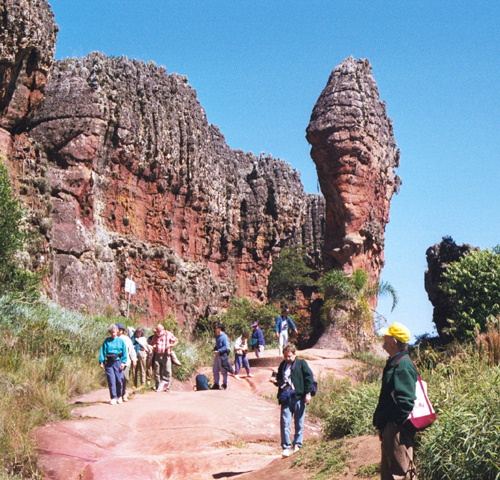
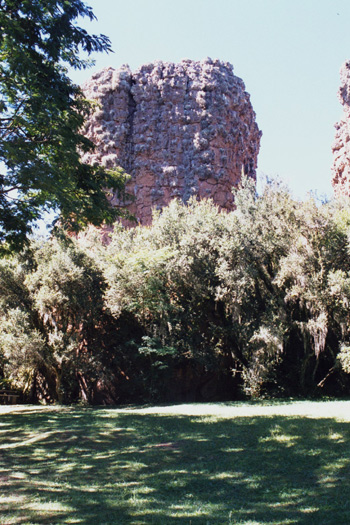
In the WildDude, you are right. This is not a gesneriad. It is indeed a big chunk of weathered rock in Vila Velha State Park, in Paraná state, Brazil, wherein can be found the reclusive Sinningia canescens. This park features a lot of interesting geology, mammalian pests called coatis, and (on occasion) gesneriad hunters. In addition, there are rhipsalid cacti, such as Lepismium cruciforme, which are normally epiphytes, but here can be found growing on steep hillsides. |
|
|
Here is the 1999 GRF expedition (Hans Wiehler is the one in the red and white shirt) straggling past yet another imposing rock formation. Somewhere around here is the lens cap for my camera, which went missing and could not be located despite diligent searching. Camera makers: always provide a tether to attach the lens cap to the camera body. |
|
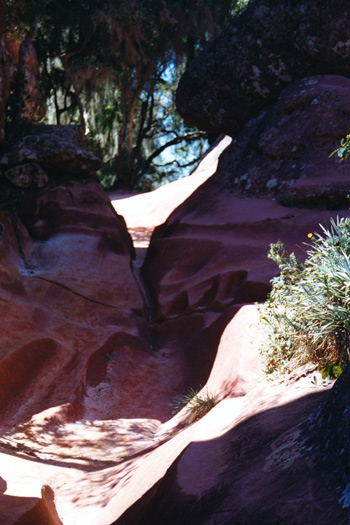
It won't be far now. Through this picturesque crevice... To tell the truth, I don't remember whether the plant was before or after the crevice. To keep on telling the truth, I was more impressed by the crevice than the plant. But that was then. |
|
|
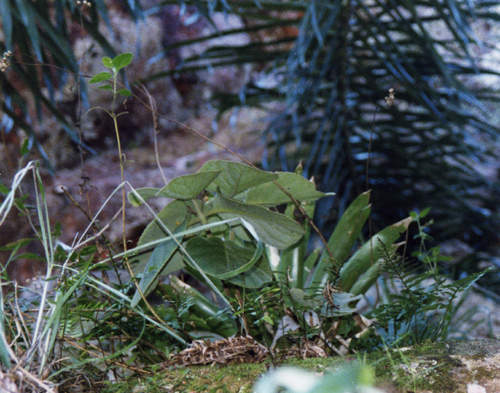
So here is the shy Sinningia canescens. Not in bloom (it was Brazil autumn, remember). But still cheerfully growing on a rock amid ferns and what looks like a gasteria to the right (but can't be because gasterias are south African). Continuing to be honest, I can't positively assert this is Sinningia canescens. The long, mostly bare stem to the left gives me pause. I am going by what was written on the back of the 1999 photograph, but I cannot remember who gave me that identification. Until such time as I receive a correction from my loyal reader, we'll go with what was on the label. |
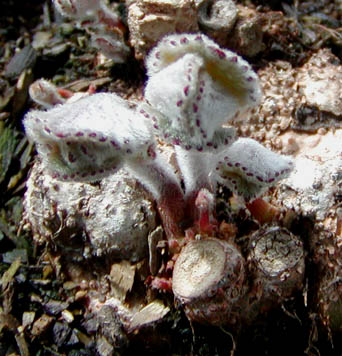
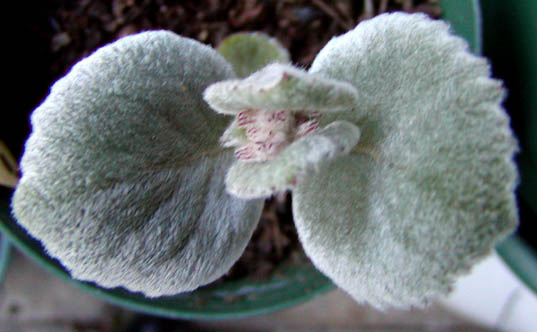
In the Tame: My plantsThe most distinctive feature of this species is the "oyster-shell" leaves on new sprouts from the tuber. The first leaf pair almost completely encloses the second leaf pair and the flowerbuds. This picture shows the leaves after they have begun to spread, revealing the flowerbuds. The densely hairy leaves would make this very popular for its foliage were it not for Sinningia leucotricha, with which it has often been confused. However, the way the leaves are held when the plant sprouts from the tuber always makes it possible to distinguish adult plants of the two species. |
|
|
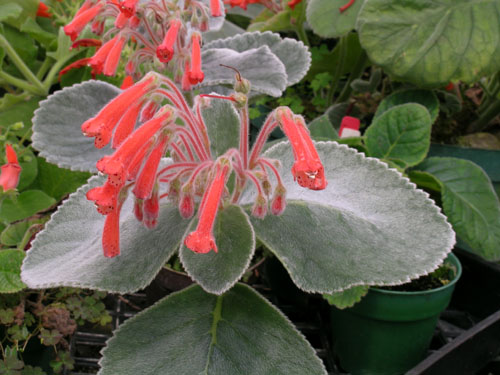
The next two photographs are courtesy of Mike Kartuz. They show actual flowers, noticeably missing from the above pictures (a shortcoming deftly concealed by witty composition). This picture shows the hairy-leaved form. Unlike most forms of S. leucotricha, this plant has more than four leaves on a stem. One striking feature is the similarity of the flowers to S. macropoda. Note the spotting on the corolla lobes. S. canescens and S. macropoda are close relatives, as can be seen in the taxonomical summary of the douglasii group of the dircaea clade. |
|
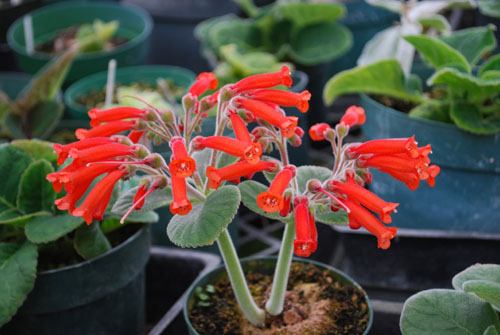
This is what Mike calls the "green-leaved form", presumably because the hairiness is not as dense. We note that this plant does have four leaves per stem. In both plants, we note that the flowers have relatively long pedicels, unlike the short ones of S. leucotricha. |
There was a lot of confusion for a long time between S. canescens and Sinningia leucotricha. The latter species was grown for many years under the names Rechsteineria canescens and Sinningia canescens.
Sinningia canescens has been much more difficult for me to keep alive. S. leucotricha is very vigorous, but S. canescens has always struggled under my conditions. At the moment [written in August 2007, still true in October 2011], I do not have any plants of this species. My last one failed to come out of dormancy in 2006.
Sooner or later, I will tackle it again.
It has crossed my mind that some of the plants in circulation as S. leucotricha or S. canescens might actually be hybrids between the two, especially since I have never seen a plant identified as such a hybrid (which would seem to be an obvious cross to make).
| Plant Description |
|
| Growth | Determinate |
| Leaves | Two or three pairs of gray-green leaves with silvery hairs |
| Dormancy | Stem completely deciduous, stumps remain on tuber. |
Flowering |
|
| Inflorescence | Flowers in terminal cluster. |
| Season | Blooms in spring |
| Flower | orange-red, tubular |
Horticultural aspects |
|
| From seed | Five years to bloom, under my conditions, but that's unlikely to be typical. |
| Hardiness | Survived 30F (-1C) in my yard. |
| Recommended? | I don't know. Mine were nice, but hard to keep alive: I eventually lost them all. Take your chances. |
Botany |
|
| Taxonomic group | The douglasii group of the Dircaea clade. |
As Gesnera canescens, by Martius, in 1829. Hans Wiehler moved this species to Sinningia in 1975.
Etymology: Latin canescens, gerund (-ing form) of canesco ("grow white or grey").
Ron Myhr's Gesneriad Reference Web has a picture showing S. leucotricha and S. canescens side by side. The picture was taken in Geneva, at the growing facility of Alain Chautems.