|
|
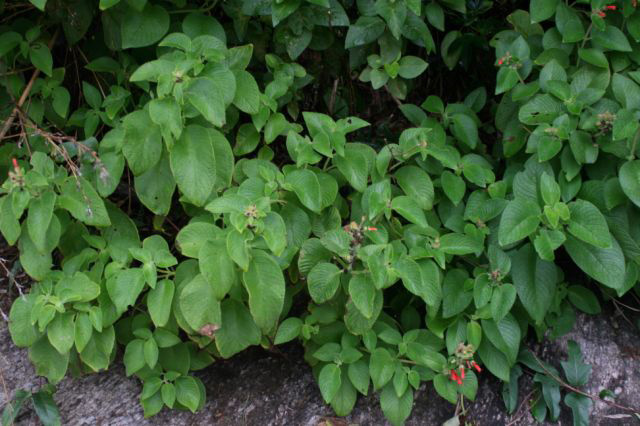
The above picture was taken by Jim Roberts in Brazil. He and Mauro Peixoto found a number of these plants growing on a beach. |
|
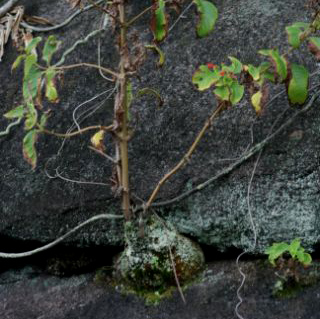
This picture, also taken by Jim Roberts, shows a Sinningia aggregata tuber wedged into rocks. Like many exposed tubers in habitat, it is covered with epiphytes, in this case probably lichens and perhaps a few mosses. |
|
Yellow-Flowered Form
|
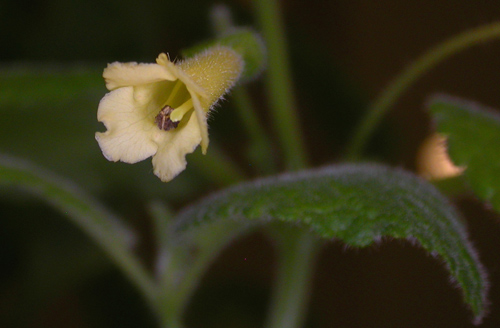
The normal type of this species has red flowers, but there is a variety which has yellow flowers. This picture, from Dale Martens, shows a flower of that variety. |
|
|
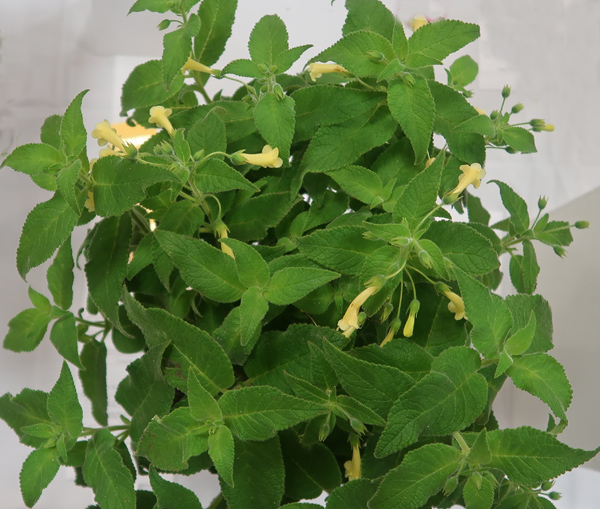
This picture shows a yellow-flowered plant displayed by Michael Riley at the 2119 Gesneriad Society convention in Cincinnati. |
Hybridization
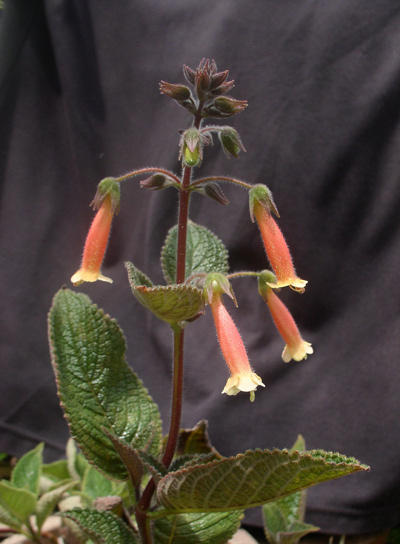
Leong Tuck-Lock's photo of his own cross S. aggregata (yellow form) with S. sellovii. |
Sinningia aggregata 'Pendulina' is one of the parents of S. 'Apricot Bouquet'.
Leong Tuck-Lock of Malaysia crossed the yellow-flowered form of this species
with S. sellovii
and obtained the plant shown in his photo at the left.
The yellow corolla lobes are an obvious inheritance from the
S. aggregata parent, while the pendant
flowers are from S. sellovii
Tuck-Lock writes that the flowers are just about an inch in length, and that
the plants resemble the pollen parent (evident from the leaf texture).
Since both parent species are in the
core group of the Corytholoma clade,
it is not surprising that Tuck-Lock has found this cross to be fertile.
|