Pinching to cause branching is ineffective with most sinningias.
Many have determinate growth
and therefore do not branch above the tuber.
Even those with indeterminate growth
will often just start (at most) one new stem from the node just below the
point where the growing tip was cut out.
Sinningia sellovii makes side shoots spontaneously,
once plant has has begun blooming on the main shoot.
Unfortunately, as both Jon Dixon and I have observed, these side shoots do not flower.
It could be that these shoots would bloom if the growing season were long
enough.
At any rate, this raises a question: would cutting back the main shoots early in
the season cause branching and thus a bushier plant with more flowers?
The Experiment
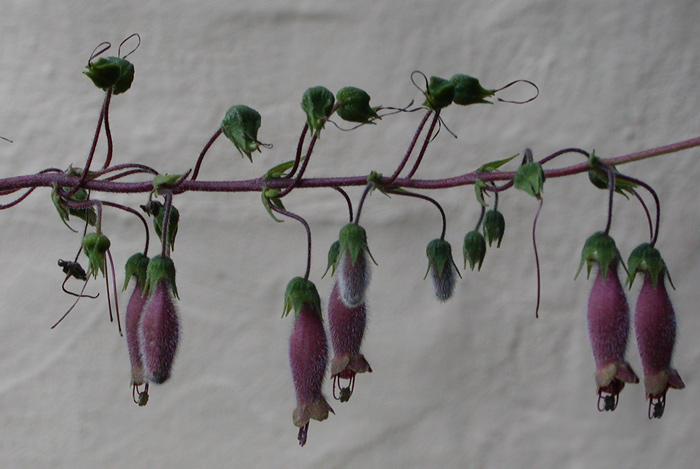
In the spring of 2010, I cut back the five main stems on a plant of
Sinningia sellovii 'Purple Rain' to a couple of
nodes above the tuber.
The plant then put out two new shoots from the node just below the cut on
all five stems.
In addition, the node below the top node put out one or two shoots on all
five stems, resulting in a total of 17 shoots.
So the plant was bushier. That was the good news.
The bad news was the flowering story.
As of this writing [August 2010], only a couple of shoots had initiated
any flowerbuds at all and then only in small numbers.
None of the flowerbuds were close to opening.
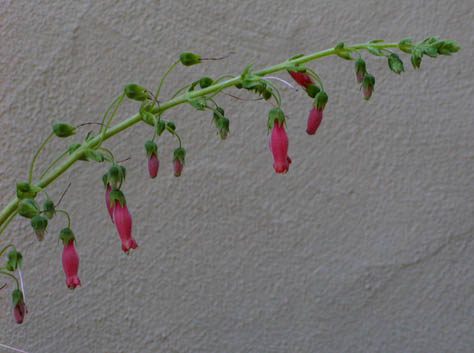
Meanwhile, both the normal variety and 'Purple Rain' had been blooming
for at least a month.
My hypothesis: a shoot of Sinningia sellovii
must reach a minimum length, maybe 20 cm [8 inches], in order to bloom.
The side shoots on an unpinched plant never reach this length in my area
and under my conditions,
so we never see flowers on those side shoots.
I am going to see flowers on some of the shoots from the pinched plant
because they had time to reach the required length, but even so, the
delay combined with many of the shoots not reaching the required length
will mean that I will get fewer flowers than I would have had I not pinched.
[Note that the experiment did give me five cuttings to root.]
A number of people have reported growing this species in the ground.
With age, the tuber gets very large.
Grown in this way (which I have not yet done), the plant is reportedly
quite hardy, tolerating winters on the mid-Atlantic coast of the United States.
The Sinningia sellovii tuber is an amorphous lump
(see a picture).
In 1999, the Gesneriad Research Foundation expedition saw this species blooming
on hillsides just below Iguassu Falls, very close to the
point where the borders of Brazil, Paraguay, and Argentina meet.
The falls are overwhelming, so wide they seem to go on forever.
Despite the grandeur, we managed to find a little attention for the sinningias.
[Iguassu, written Iguaçu in Portuguese, would be accented
on its final syllable, as are all Portuguese words ending in -u, unless
overridden by an accent marker elsewhere in the word.
The pronunciation would therefore be approximately ee-gwa-SOO.]
In the Tupí language, i-guassu means water-big,
which is a huuuge understatement.
Sinningia 'Demon' is
Sinningia sellovii x
elatior.
It represents one sort of solution to the
no-flowers-on-branches problem discussed
above.
|