| Species list |
Hybrids list |
Tubers list |
Topics list |
Site index |
What's new |
Home page |
Normally, I hate it when one of my sinningia-tribe plants dies. I made an exception for Paliavana prasinata.
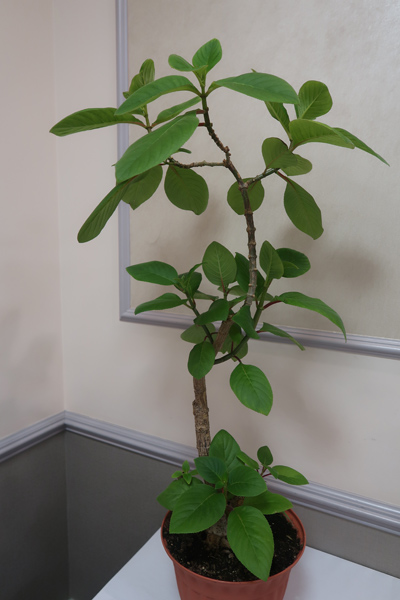
I had a P. prasinata plant for many years and it never bloomed. It took up a lot of space, and required a lot of water even though it was in a big pot. It would usually drop all its leaves every winter. Finally, one winter, it expired altogether.
I don't miss it.
If you have to grow one Paliavana, choose P. tenuiflora.
I grow them in somebody else's house. Or greenhouse. Or under somebody else's lights, in their painstakingly prepared potting mix.
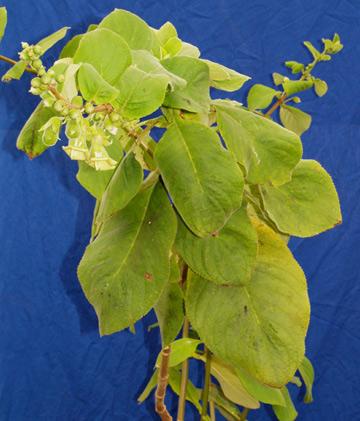
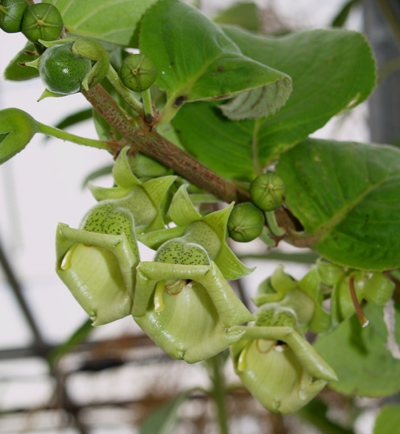
In the case of Paliavana prasinata, Jon Lindstrom is growing it for me in his greenhouse at the University of Arkansas. The two pictures on this page are his pictures of his plant.
This picture shows the flowers. Greenish, campanulate, speckled on the outside, and with the corolla lobes curled back as reinforcement, the flowers are most probably pollinated by bats.
Bats?
Bats have been recognized as flower pollinators since at least the beginning of the twentieth century. (See a discussion in Proctor, Yeo, and Lack, pp. 244-255.) Since bats are nocturnal and larger than insect or hummingbird pollinators, bat flowers tend to be white or greenish (more visible at night), larger and sturdier than other flowers, and with wider openings.
Among the gesneriads pollinated by bats are Kohleria allenii and what used to be called Capanea grandiflora but is now a kohleria (I can't remember the new species name).
The picture shows some green globular objects which might be slightly ambiguous. Are they flowerbuds or unripe fruits?
The answer lies in the five-pointed star design on the front of the objects. If these were fruits, they would each have a verticle seam dividing the fruit into two halves. The five-part division shows that these are calyxes, with five valvate calyx lobes. The calyx completely encloses the developing flowerbud, which both protects the bud and prevents premature pollinator visits.
I have to admit the flowers are slightly cool, but the plant? Best in somebody else's yard!
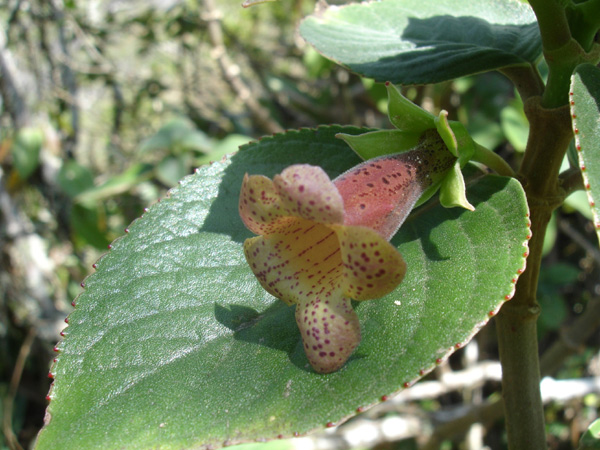
This picture, sent to me by Alain Chautems and taken by Ludovic Kollman, shows a plant believed to be a natural hybrid between Vanhouttea calcarata and Paliavana prasinata. It was found in the wild in Espírito Santo state (Brazil) by Ludovic Kollmann, who confirmed that the supposed parents Paliavana prasinata and Vanhouttea calcarata were growing nearby.
I have to say this hybrid looks way more attractive than either parent.
| Plant Description |
|
| Growth | Indeterminate |
| Habit | Erect stem with few branches |
| Leaves | Green |
| Dormancy | Leaves deciduous in cold weather |
Flowering |
|
| Flowering season | None |
| Flower | campanulate |
Horticultural aspects |
|
| Hardiness | It survived 32F (0C) in my yard. For a while. |
| Recommended? | No. Mine never bloomed. |
Botany |
|
| Taxonomic group | In the paliavana subgroup of the Sinningia clade. |
| Pollinator | Bats |
For some habitat pictures and information, see the page on Mauro Peixoto's web site.
Latin prasinata, from prasina ("green"). For you fans of classical history and/or equestrian sports, factio prasina ("the Greens") was one of the two horse-racing factions in the Roman and Byzantine Empires.