Vanhouttea leonii
| Species list |
Hybrids list |
Tubers list |
Topics list |
Site index |
What's new |
Home page |
Vanhouttea leonii |
|
|
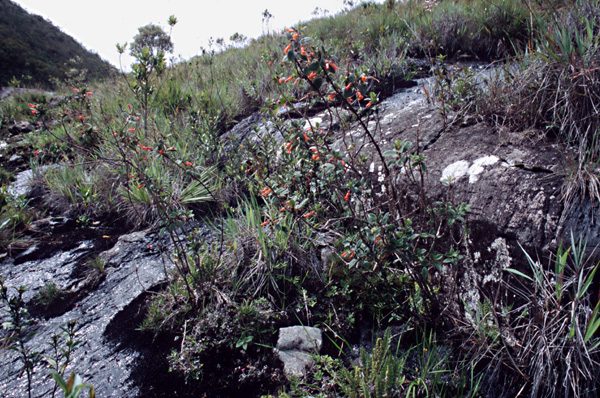
This picture, courtesy of Alain Chautems, shows Vanhouttea leonii in habitat. It appears we should be growing our vanhoutteas in the crevices of rocky outcrops, surrounded by plenty of weeds. The rocks may allow the plant to get plenty of sunlight while protecting the roots from drying out too much. |
|
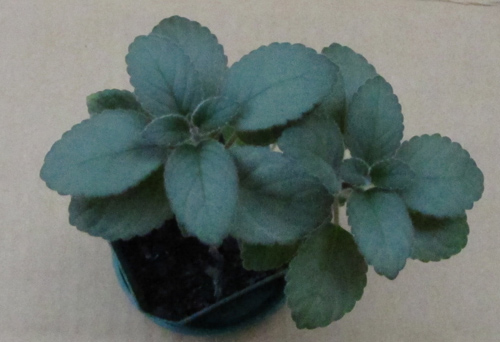
This picture shows a seedling, started from Brazil Plants seed. At this time [September 2013], the plant was about 14 cm [5.5 inches] tall, and growing in a 3-inch pot. Vanhouttea leonii, at least under my conditions, seems to be shrubbier and more compact than other vanhoutteas. |
|
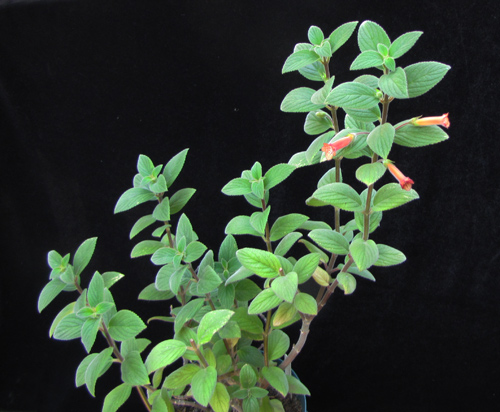
This is my plant, photographed in September 2016. Obviously it is not a heavy bloomer. Cutting the stems back after flowering keeps the plant relatively compact. |
|
Mauro Peixoto believes that my plant may be a natural hybrid of the true Vanhouttea leonii and Vanhouttea pendula, which grows not too far from V. leonii. He bases this mostly on the corolla color, which differs a little from that of the parent plant (from where the seeds that I sowed were gathered). Arguing against this is the shortness of the corolla on my plant (only 3 cm, while V. pendula corollas are 4 cm or more longer) and the corollas on my plant being held horizontally (as opposed to pendant on Vanhouttea pendula). Feature table for Vanhouttea leonii
External LinkMauro Peixoto's web site has a page about Vanhouttea leonii. PublicationAlain Chautems described V. leonii in his 2002 paper. This species grows in Minas Gerais state of Brazil, in the same general area as V. pendula, namely the mountains near where the three states of Minas Gerais, Espírito Santo, and Rio de Janeiro meet. | ||||||||||||||||||||||||||||||||||||||