| Species list |
Hybrids list |
Tubers list |
Topics list |
Site index |
What's new |
Home page |
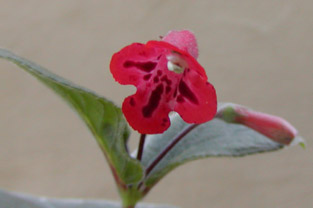
I crossed S. douglasii with S. leucotricha in 2004. This was hardly the first time this cross had been done -- see the crossing chart). The first flower appeared in May 2007 (neither parent species is quick to bloom from seed). The parents are two of my favorite species, so I was curious to see what the result of crossing them would be. The hybrid could be a stepping stone to a nice combination, and I've harvested F2 seed from this plant. (I also note that Mauro Peixoto's Brazil Plants club offers leucotricha x douglasii F2 seed.)
The flower resembles that of S. douglasii, but is just a little smaller. At this stage, certainly, the plant is nowhere near as floriferous as S. douglasii.
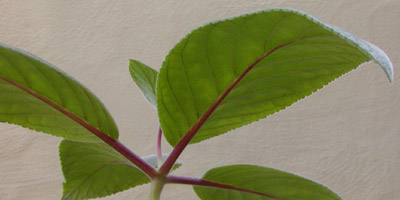
The foliage is intermediate between the two parents. The leaf is definitely hairy, but the hairs are not as conspicuous as those of S. leucotricha.
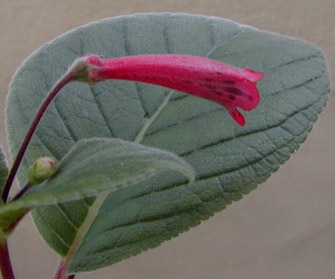
Vincent Parsons, on the Gesneriphiles mailing list, has said that he made crosses between S. leucotricha and various other sinningias, and even back-crosses to S. leucotricha, without recovering the full leucotricha foliage.
The leafbacks look a lot like those of S. douglasii, with the dark red petiole and midrib.
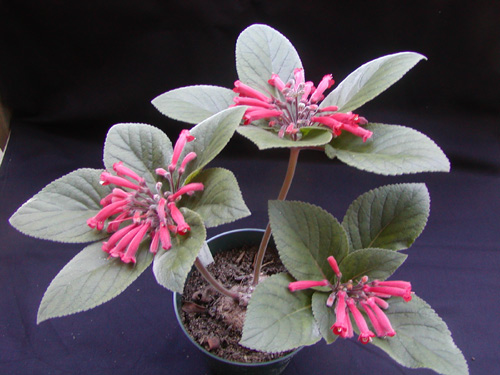
As with many sinningias, this plant has improved with age. This doesn't mean that an individual flower or leaf looks better, but that the plant as a whole is more attractive: more stems, more flowers, and better growth habit. The picture above shows the plant in June 2009, from seed sown in 2004.
| Plant Description |
|
| Growth | Determinate |
| Habit | Stems upright (if one) or spreading (more than one) |
| Leaves | Dark green with red midrib and veins prominent on reverse |
| Dormancy | Stems fully deciduous. Dormancy appears to be obligate, just like that of both parents. |
Flowering |
|
| Inflorescence | terminal cluster (like S. leucotricha but not S. douglasii, which has a terminal peduncle) |
| Season | Summer |
| Flower | Red, tubular |
Horticultural aspects |
|
| Hardiness | Has survived 30F (-1C) in my yard. |
Hybridization |
|
| Hybridizer | Alan LaVergne |
| Fertility | As would be expected, this hybrid (both parents in the Dircaea clade) is fertile, and I have selfed it and done crosses with it. |
Botany |
|
| Taxonomic group | Parents are both members of the Dircaea clade. |