| Species list |
Hybrids list |
Tubers list |
Topics list |
Site index |
What's new |
Home page |
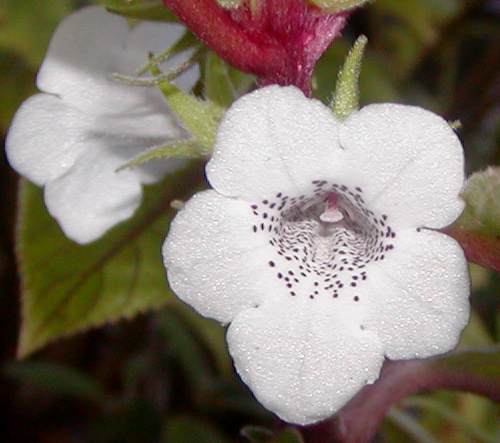
Sinningia schiffneri has two forms in cultivation. One has plain green leaves and stems, and the other (shown in the picture) has red petioles and red veins on the leaf backs. The latter form is more attractive. Attractive vegetative growth is important because S. schiffneri doesn't produce a lot of flowers, and the ones it does produce are relatively small.
The plant does not branch readily. Almost all the branching is at or near the base. This is in contrast to its relative, Sinningia gerdtiana, which branches at every opportunity. These two species are the only sinningias which never form tubers. Their next closest relative is the bizarre Paliavana plumerioides.
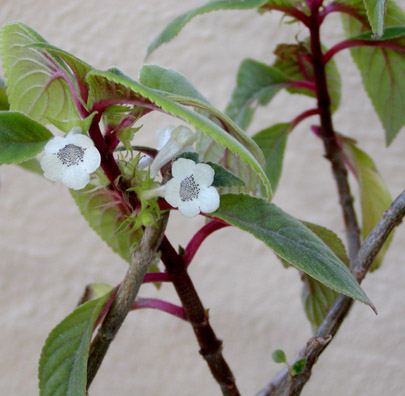
This plant was grown by Jon Dixon.
| Plant Description |
|
| Growth | Indeterminate |
| Habit | Upright or spreading stems, branching mostly at base, leaves often deciduous, leaving stem bare for much of length |
| Leaves | Green. One form has red hairs. |
| Dormancy | No tuber |
Flowering |
|
| Inflorescence | Axillary cyme, usually one flower. My largest plant has occasionally had two flowers per axil. |
| Season | Blooms in summer to early autumn |
| Flower | White, funnelform, spotted purple |
Horticultural aspects |
|
| From seed | Two years to bloom, under my conditions |
| Hardiness | Has survived 30 F (-1 C) in my yard, but lost all its leaves. Did not survive 28 F (-2 C). |
| Recommended? | Yes, if you can obtain the red-leaved form. |
Botany |
|
| Taxonomic group | The thamnoligeria clade. |
S. schiffneri was first described by Fritsch in 1908. Its first known commercial listing was in the 1964-65 Kartuz catalog.